How many words do you need to read English news?

There is no single number, but there is a threshold. Once you know about ninety-eight percent of the words on a page, roughly one unknown word every fifty, you can read straight through and infer the rest from context. Below that you are decoding rather than reading.
This question usually gets answered with a round number. Three thousand words. Five thousand. I think the number is the least interesting part of it, so this post is about the part that actually decides whether you can read the article.
So how many words do you need?
It is a ratio problem, not a total. What determines whether you read fluently is how often you hit a word you do not know, not how many you know altogether.
Run the arithmetic. Knowing ninety percent of the words on a page sounds excellent, but it means one unknown word in every ten. A news sentence runs past twenty words, so you stall roughly twice per sentence. That is not reading, that is translating.
Ninety-five percent gets you to one in twenty, about one stall per sentence. Still exhausting. Around ninety-eight percent you are down to one unknown word in fifty, so every two or three sentences, and that is the point where you can guess from context instead of stopping.
TODO_STAT — Add the specific word-family count that corresponds to ninety-eight percent coverage of journalistic prose, with the research citation. Deliberately left blank rather than guessed, since this is exactly the kind of number that needs a real source.
Why is ninety-five to ninety-eight the hard part?
Because the words in that gap are not common ones. The first few thousand words turn up everywhere, so you absorb them almost automatically. The further up you go, the rarer each new word is, and the fewer chances it gets to repeat often enough to stick.
This is precisely where list-based study runs out. You can cram three hundred words in a fortnight, but if you never meet them in a real sentence afterwards, most will drain away. Not because you were lazy. Because your brain drops what it does not use.
That is also where I gave up on the vocabulary apps I had installed. I would learn a few hundred words, come back three weeks later, and be starting over.
How do you get enough repetitions, then?
By letting new words appear inside the things you already read every day. If you are Vietnamese you are already reading VnExpress, Vietnamese Wikipedia and Facebook. The volume is not the problem. The problem is that none of those words are in English.
Merid inserts them. It swaps a small number of Vietnamese words on the page in front of you for their English equivalents, so new vocabulary arrives inside a real sentence rather than on a flashcard.
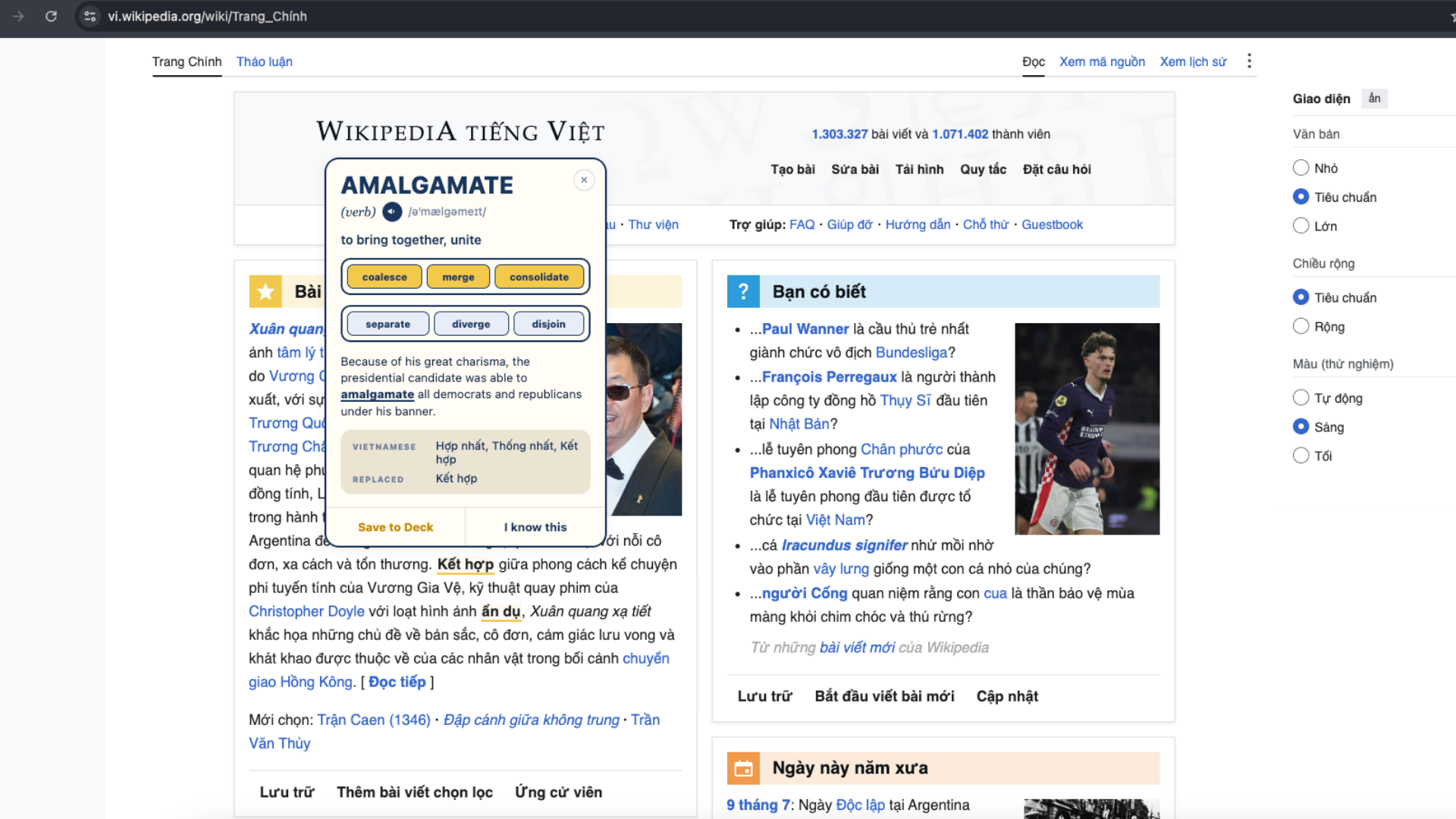
Nothing extra opens. No study session appears in your calendar. The words come to where you already are, while you are reading something you actually care about.
Which word list should you start with?
Pick by target, and run one at a time. Merid ships three lists. These are their real sizes:
| List | Words | Who it suits |
|---|---|---|
| SAT | 988 | Sitting the SAT, or wanting an academic base |
| C1 | 1,379 | Reading news comfortably and writing better |
| C2 | 977 | Already reading fine, want harder material |
That is under three and a half thousand words in total, which is smaller than the figures thrown around in most articles on this question. It is deliberately smaller. These are chosen words rather than a list padded to hit a round number, and each entry carries a Vietnamese gloss, pronunciation, an example sentence, synonyms and antonyms.
If you are preparing for one specific exam or reading in one specific field, building your own list beats switching all three on.
How should you measure progress without fooling yourself?
Count words you have marked as known, not minutes studied. Minutes tell you nothing. Words you recognise on sight the next time they appear tell you something.
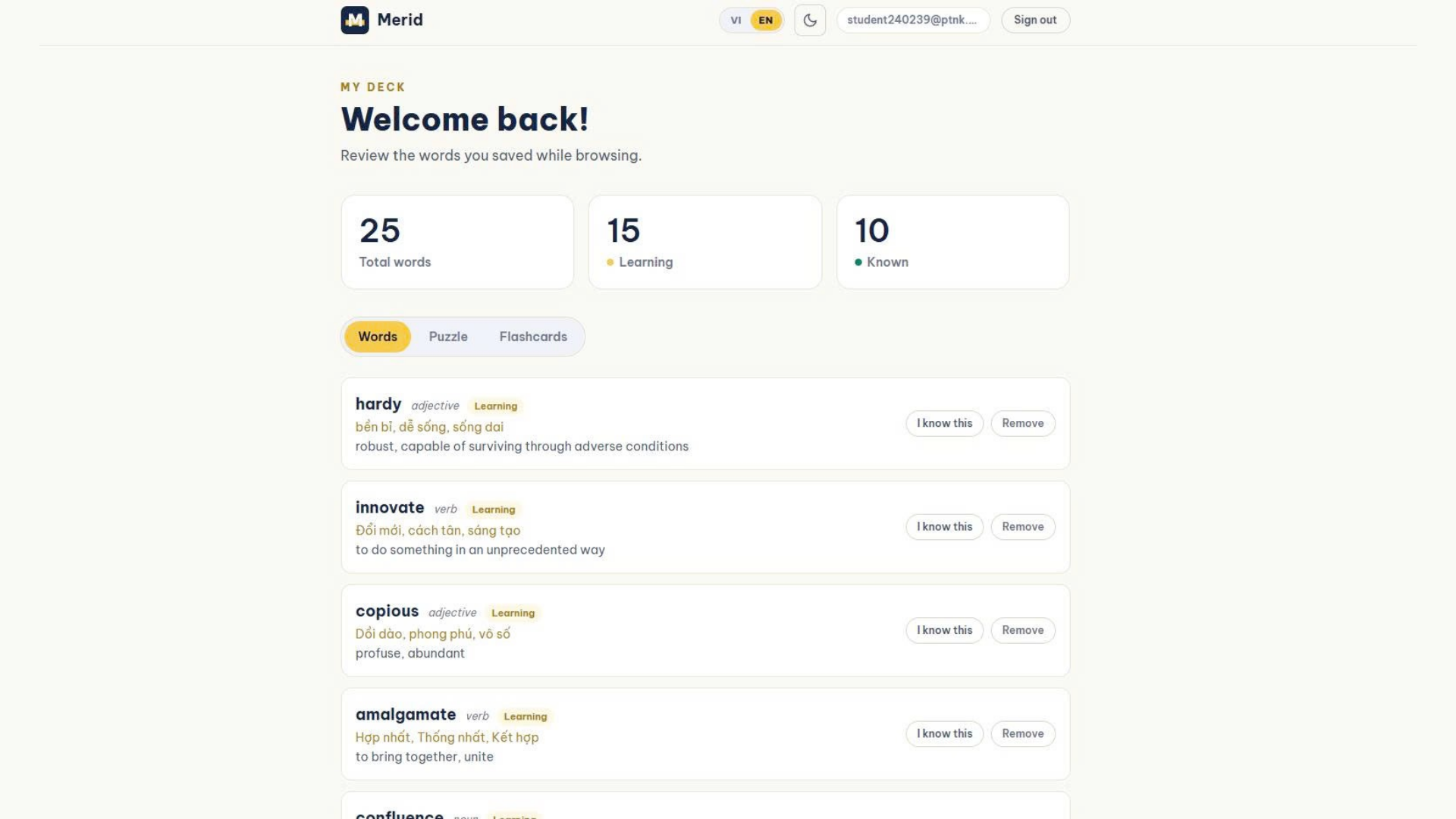
That is my own deck at the time of the screenshot. Twenty-five words, fifteen in progress, ten known. It contains hardy, innovate, copious, amalgamate and confluence.
I never sat down and studied any of them. They showed up while I was reading, I kept them, and by the third encounter I marked them known. Twenty-five is a small number. It is also twenty-five words that cost me no separate study time at all.
What is the number, then?
The rhythm matters more than the total. Meet a few new words in real sentences every day, keep that up over months, and you will cross ninety-eight percent coverage without ever having counted.
If you want a target anyway, set it weekly rather than cumulatively. Choose one list, keep the swap intensity low, and read the way you were going to read regardless.
Frequently asked questions
- Is memorising a three thousand word list faster?
- Faster on paper, slower in practice. Most words learned outside a sentence fall out again within weeks. Words met in real context stay longer.
- Which list should I start with?
- SAT if you are sitting the SAT. C1 first and C2 later if you want to read news comfortably and write better. Do not switch all three on in your first week.
- How long until I notice a difference?
- I am not going to give you a number, because it depends entirely on how much you read per day. The first measurable thing is the size of your own deck.
Try Merid on the page you are reading
Merid swaps a few words on the pages you already open for English vocabulary worth knowing. Free, and it runs on your own machine.